Decoding HDAC Inhibitor Assembly

Reflecting work in the Challis & Alkhalaf Labs

Published here August 7, 2026

Molecular basis for depsipeptide HDAC inhibitor combinatorial biosynthesis

Munro Passmore, Xinyun Jian, Xinyi Zhao, Emmanuel L. C. de los Santos, Douglas M. Roberts, Józef R. Lewandowski, Matthew Jenner, Lona M. Alkhalaf, Gregory L. Challis

Nature Communications 2026, 17, 5508. https://doi.org/10.1038/s41467-026-74383-4

View Original Publication


Romidepsin, an approved treatment for T-cell lymphomas, belongs to a family of bicyclic depsipeptides that inhibit class I histone deacetylases, HDACs. Every member of this family shares a conserved Zn2+-binding pharmacophore, yet each carries a structurally distinct peptidyl cap that modulates isoform selectivity by contacting the outer rim of the HDAC active-site tunnel. Biosynthetically, the pharmacophore and cap are assembled by separate polyketide synthase, PKS, and nonribosomal peptide synthetase, NRPS, machineries that must interface precisely. How the conserved pharmacophore apparatus engages productively with structurally diverse cap biosynthetic systems, enabling the natural combinatorial biosynthesis that generates this structural diversity, was largely unresolved.

Researchers in the Gregory L. Challis and Lona M. Alkhalaf Groups at the University of Warwick and the ARC Centre of Excellence for Innovations in Peptide and Protein Science at Monash University, published in Nature Communications, used gene proximity searching of the antiSMASH database to locate the long-sought biosynthetic gene cluster, BGC, for FR-901375 in Pseudomonas chlororaphis subsp. piscium DSM 21509. The team then combined in vitro reconstitution of chain elongation across the PKS-NRPS interface, site-directed mutagenesis, AlphaFold 2 structural modelling, carbene footprinting mass spectrometry, and molecular dynamics simulations to dissect the docking mechanism that links the conserved pharmacophore machinery to the variable cap machinery across four related assembly lines.

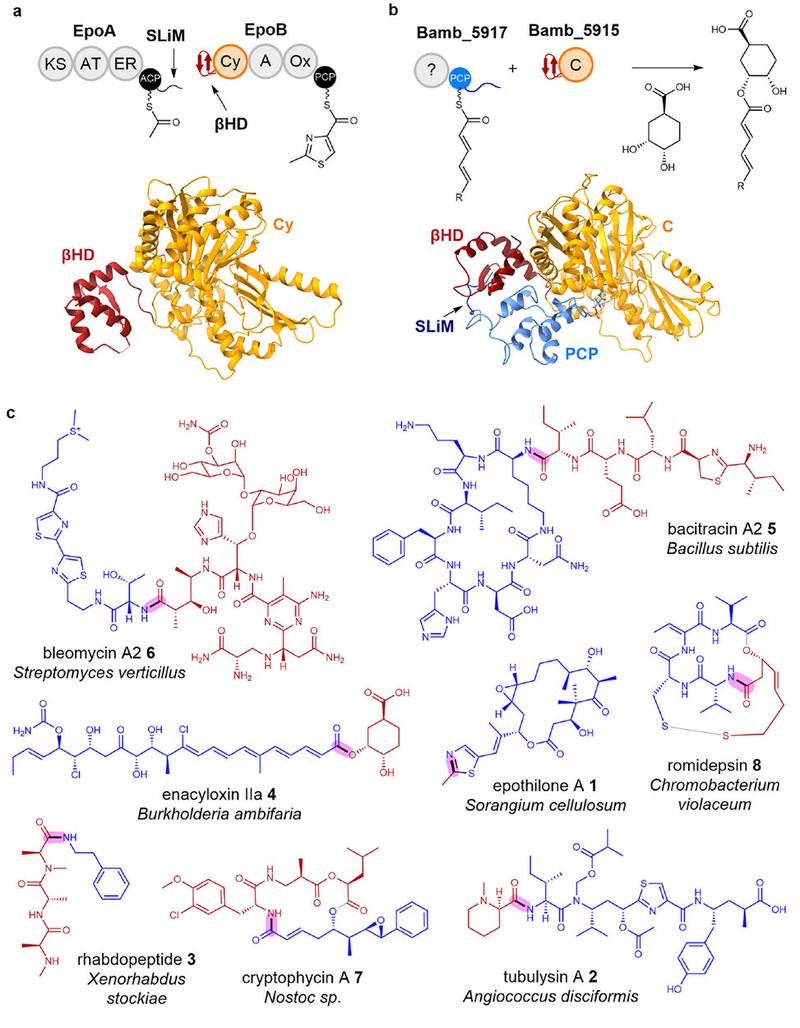
The FR-901375 BGC in P. chlororaphis subsp. piscium DSM 21509 encodes a four-module NRPS, PcdK, predicted to assemble a D-Val–D-Val–D-Cys–L-Thr tetrapeptidyl cap. Gene deletion of pcdK abolished FR-901375 production, confirming BGC identity. The docking elements at the PKS-NRPS junction, a short linear motif, SLiM, appended to the C-terminus of the final pharmacophore ACP domain and a β-hairpin docking, βHD, domain at the N-terminus of the first cap NRPS subunit, proved to have asymmetric contributions. In-frame deletion of the βHD domain eliminated FR-901375 production in vivo and abolished condensation activity in vitro, whereas deletion of the SLiM caused only a modest reduction comparable to mutation of a single hydrophobic residue to a charged isostere, V101D, in the ACP domain. Comparative BGC analysis suggests the FR-901375 BGC evolved from a spiruchostatin BGC ancestor via horizontal transfer of a burkholdac NRPS gene followed by successive duplication and recombination events that remodeled cap assembly while retaining pharmacophore machinery.

AlphaFold models of the ACP-SLiM/βHD-C di-domain complex revealed that the βHD domain engages not only the SLiM, as seen in the enacyloxin IIa and other previously studied systems, but also binds directly to a conserved epitope on the globular ACP domain. A hydrophobic protuberance formed by Val101 and Thr102 at the C-terminus of the last ACP α-helix nestles into a hydrophobic pocket on the βHD domain, while Arg21 and Glu97 on the ACP domain form salt bridges with each other and with residues Asp12 and Glu97 of the βHD domain. Carbene footprinting mass spectrometry confirmed masking at the predicted ACP-βHD interface and at the ACP-C domain contact region, consistent with the modelled complex. Mutagenesis of Arg21, Glu97, Val101, and Thr102 each reduced condensation activity, validating the interaction epitope. Productive in vitro crosstalk between all pairwise combinations of ACP-SLiM di-domains and βHD-C-A-PCP tetra-domains from the FR-901375, romidepsin, burkholdac, and spiruchostatin systems confirmed that the conserved ACP-βHD epitope enables non-cognate pharmacophore and cap machineries to engage functionally.

These findings establish the molecular basis for combinatorial biosynthesis within the depsipeptide HDAC inhibitor family and trace a plausible evolutionary path for BGC diversification. The conserved ACP-βHD interaction epitope identified here provides a structural framework for engineering hybrid PKS-NRPS assembly lines, with potential applications in generating new analogues of romidepsin and related anticancer agents with altered cap structures and isoform selectivity profiles. The work also offers a rational starting point for identifying the still-elusive BGC for largazole by defining the bioinformatic signatures shared across this compound class.



Author

Dr. Lona Alkhalaf obtained an MChem from the University of Liverpool in 2010 and completed a Ph.D. in Chemical Biology at the University of Warwick in 2014 under the supervision of Prof. Greg Challis. She then moved to the University of British Columbia, Vancouver, working with Prof. Kaity Ryan from 2014–2016, before returning to Warwick as a Senior Research Fellow in Prof. Challis’s group. She now co-leads the Challis/Alkhalaf group at Warwick and was promoted to Associate Professor in 2026. Her research interests span natural product biosynthesis, mechanisms of action, enzyme mechanism, and enzyme engineering.

Author

Dr. Xinyun Jian received an MSc in Microbial and Biochemical Pharmacy from Wuhan University in 2015, prior to joining the Challis group at the University of Warwick, where she earned a Ph.D. in Chemistry and conducted postdoctoral research in the Warwick Integrative Synthetic Biology Centre. In 2022, she moved to the ARC Centre of Excellence for Innovations in Peptide and Protein Science, CIPPS, at Monash University, where she is currently a research fellow in the Challis and Cryle groups. Her current research exploits interdisciplinary approaches to elucidate the biosynthesis of bioactive natural products and develop chemoenzymatic strategies for their engineering.

Author

Xinyi Zhao is currently a Ph.D. student at Monash University, supervised by Professor Gregory Challis and Dr. Xinyun Jian. She received a Master’s degree in Biological and Pharmaceutical Engineering from Zhejiang University, China, and subsequently worked as a research assistant at Westlake University. In 2025, she joined the Challis lab at Monash to pursue doctoral research on the biosynthesis of natural products. Her current research focuses on elucidating the enzymatic mechanisms underlying amino fatty acid biosynthesis and developing biocatalytic strategies for the generation of novel bioactive molecules.

Author

Prof. Greg Challis holds a joint appointment as the Monash Warwick Alliance Professor of Sustainable Chemistry, Chemical and Synthetic Biology, in the Department of Chemistry at the University of Warwick, where he co-leads a research group with Dr. Lona Alkhalaf, and as a Distinguished Research Professor in the Biomedicine Discovery Institute at Monash University, where he is a Chief Investigator in the ARC Centre of Excellence for Innovations in Peptide and Protein Science and the ARC Training Centre in Sustainable and Green Economy Manufacturing. His research interests encompass the discovery, biosynthesis, bioengineering, mechanism of action, and biological function of bioactive specialised metabolites from microbes, elucidating the catalytic mechanism of unusual biosynthetic enzymes, and harnessing such enzymes as biocatalysts for green and sustainable synthesis of structurally complex high value products.

Decoding HDAC Inhibitor Assembly

Fig. 1 | Molecular basis for SLiM/βHD domain-mediated subunit interaction in hybrid PKS-NRPS and NRPS assembly lines and structures of selected bioactive products biosynthesised by systems employing these docking elements. a | SLiM/βHD domain-mediated interaction of EpnA and EpnB in the hybrid PKSNRPS that assembles epothilones, top, and X-ray crystal structure of the excised EpoB βHD-Cy di-domain, bottom; PDB ID: 5T7Z. b |SLiM/βHD domain-mediated interactions of Bamb_5917 and Bamb_5915, involved in PKS chain release during enacyloxin IIa biosynthesis, top, and a model of the PCP-SLiM/βHD-C tetradomain complex based on an X-ray structure of Bamb_5915, PDB ID: 6CGO, and NMR structures of the excised Bamb_5917 PCP-SLiM di-domain, bottom. c | Structures of selected natural products assembled by hybrid PKS-NRPS and NRPS systems employing SLiM/βHD domain interactions, including several used clinically - bleomycin, bacitracin, epothilone and romidepsin - and others with strong potential to address unmet clinical needs. The diverse taxonomic origin of these systems highlights that SLiM/βHD docking domain-mediated interactions are of widespread importance in bacterial specialised metabolism. The bond formed due to the SLiM/βHD domain-mediated interaction is highlighted in pink, resulting in a union between the fragments coloured blue and red in each example.


Author

Dr. Munro Passmore obtained an MChem degree in Chemistry from the University of Warwick in 2019, where he stayed to complete Ph.D. studies under the joint supervision of Prof. Greg Challis, Dr. Lona Alkhalaf, and Dr. Matt Jenner in 2023. Now working as a postdoctoral research fellow in the Challis/Alkhalaf and Lewandowski groups, he utilises a combination of in vitro enzyme activity assays, biophysical characterisation techniques, and computational modelling to explore and exploit protein-protein interactions in the biosynthesis of bioactive natural products.